Forty years. Three generations. One line.
For over 40 years, our family has been devoted to the art of cashew crafting, preserving a rich legacy across three proud generations.
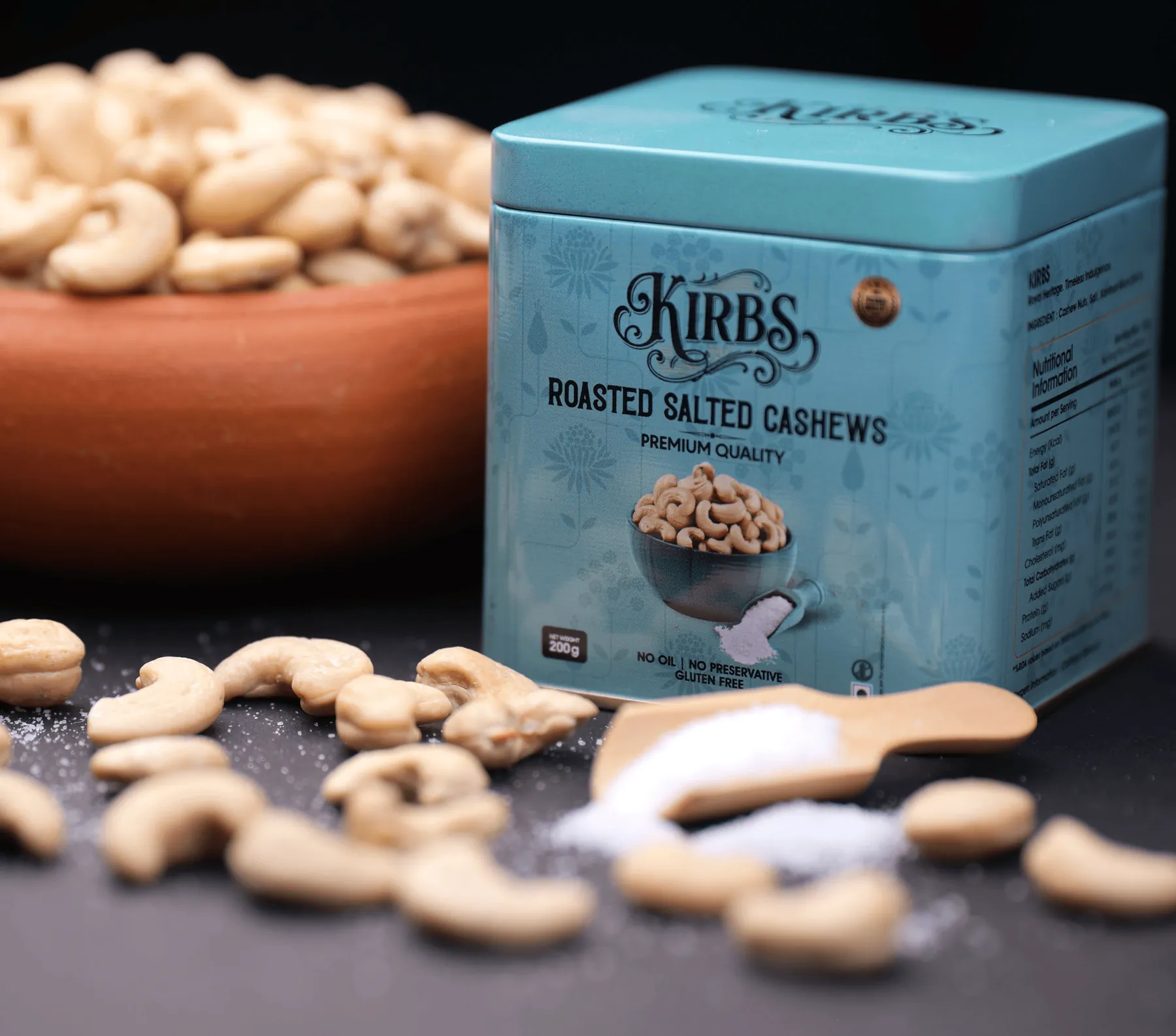
KIRBS is the first time that work carries our own name: five tins, each graded and packed in Nellikavilai, each holding nothing but what its label says.
Why a kolam?
Before sunrise in homes across Tamil Nadu, someone sweeps the doorstep, sprinkles it with water and draws a kolam in rice flour. First comes a grid of dots, the pulli. Then a single line loops around every one of them and comes back to where it began, without the hand ever lifting.
Nobody learns a kolam from a book. A child watches it drawn at the same doorstep, morning after morning, and then draws it. That is how our family has passed on the cashew trade too.
The line on this page is drawn the same way: one stroke around every dot, closing where it began. Scroll and watch it close.
From the land's end.
KIRBS is made by AVK Exports in Nellikavilai, in Kanniyakumari District, the southernmost district of mainland India, where the Arabian Sea, the Bay of Bengal and the Indian Ocean meet.
Forty years in one place builds a kind of cashew knowledge that can't be hurried: which lot to buy, when a roast is done, what a good kernel looks like at a glance.
How a cashew reaches the tin
Every cashew in the world takes a long road from tree to snack bowl. These are the steps behind each KIRBS kernel.
-
Harvest
The cashew grows outside its fruit, hanging beneath the cashew apple. When the apple ripens and falls, the nut is gathered by hand from the ground.
-
Sun-drying
Raw nuts are spread out and dried in the sun so they keep until they are shelled.
-
Shelling
The hard shell holds a caustic oil, so the nuts are steamed or roasted before the shell is cracked and the kernel lifted out whole.
-
Drying and peeling
Kernels are dried in a borma oven, which loosens the thin russet skin so it can be peeled away. Our Borma tin keeps that skin on.
-
Grading
Every kernel is sorted by size, colour and wholeness. Only the largest wholes become W180, our Jumbo grade.
-
Roasting and the tin
Our roasted cashews are roasted without oil and seasoned with salt, pepper or chilli, then sealed into the tin that matches them.
What stays the same, generation to generation
- Only what's on the label. Cashews, and where the name says so, salt, pepper or chilli. Nothing else goes in the tin.
- No oil in the roast. The cashew carries its own richness; it doesn't need more.
- Grade before anything else. A good tin starts with sorting, which is why Jumbo is sold by its grade, W180.